Framing CripTech Process of the Incubator
- Leonardo/ISAST
- 2021 – 2023 (Inaugural Cohort)
- 5 artists

About the Leonardo CripTech Incubator
Video: CripTech Incubator Introductory Video
The Leonardo CripTech Incubator is an art-and-technology program centered on disability innovation, organized by Leonardo/ISAST, with its inaugural fellowship cohort running between 2021 through 2023.
Over that arc — an open call, a year of residencies across California, and a culminating season of exhibition and publication — the Incubator brought together a cohort of disabled artists with technologists, researchers, students, and one another to make new work at the intersection of disability, art, and technology.
But a list of dates and outputs undersells what the Incubator actually was: an experiment in how an arts program itself could be built. The intent behind the Incubator was to treat access as its animating creative principle rather than a box to check — from the application form to the studio to the gallery floor.
Incubator timeline
A high-level view of the Incubator, from first funding to the Leonardo special issue.
-
Dec 2020
Funding and Support
Support received from the California Arts Council for CripTech Incubator program
-
Spring 2021
Open call launches
Two-round application
-
Late 2021
Inaugural cohort announced
Meesh Sara Fradkin, Carmen Papalia, Josephine Sales, Andy Slater, Olivia Ting, moira williams* each provided $11,000 stipend plus dedicated access funding
-
Jan–Dec 2022
Year-long residencies begin
Berkeley Disability (RadMad) Lab — Carmen Papalia, moira williams*
Beall Center, UC Irvine — Josephine Sales
Additional program support received from Ford Foundation and Ability Central -
Spring 2022
16-week residencies
ThoughtWorks Arts — Andy Slater, Olivia Ting
-
16 March 2022
Works-in-progress presentations
Virtual launch event; cohort shares projects in development
-
July–Aug 2022
Summer residency
SBCAST, Santa Barbara — Meesh Sara Fradkin
8-week onsite intensive -
Throughout 2022
Cohort cadence
Weekly cohort meetings facilitated by Leonardo
Workshops with Aimi Hamraie and Sins Invalid
Documentation check-ins with Ground Works -
2023
Culminating season
E.A.A.T. exhibition
Call for submissions to a special issue of Leonardo -
2024
Special Issue
E.A.A.T Exhibition closes
Leonardo Special Issue released
* moira williams did not complete the fellowship and was a fellow until February 2023
Why “crip”? Why “tech”?
Within disability culture, crip names disability as a valued cultural and political identity — and, just as importantly, a practice: disabled makers hacking, remaking, and repurposing environments and technologies that were never designed for them. The Incubator’s co-directors, Lindsey D. Felt and Vanessa Chang, grounded the program in what scholars Aimi Hamraie and Kelly Fritsch call crip technoscience — the insight that disabled people are not passive recipients of technology but its most inventive users and fiercest critics.
Seen this way, “technology” stretches well beyond screens and code. Prosthetics, ramps, captions, audio description, haptic interfaces, neural networks, the built environment itself: all of it is material for artists to take apart and reimagine. The Incubator asked what happens when access stops being an accommodation added at the end — a compliance measure, a retrofit — and becomes instead the creative engine of the work from the beginning.
— Lindsey D. Felt and Vanessa Chang, "Cripping Media Art Ecologies" (2022)
Origins in Recoding CripTech
The Incubator grew out of an earlier experiment: Recoding CripTech, a multidisciplinary exhibition curated by Felt and Chang at San Francisco’s SOMArts in 2019–2020, designed for, with, and by the disability community. The questions that show raised — could access be an aesthetic and design principle rather than a measure of minimal compliance? — became the founding provocations of the Incubator. Where the exhibition had tested those ideas in a gallery, the Incubator scaled them up into an entire ecology of residencies, workshops, documentation, publication, and education.
The project site has more information: https://www.recodingcriptech.com/
Video: Recoding CripTech (Preview video)
An open call, designed
The Incubator’s commitments were visible from its first public act: the application. Launched in spring 2021 with support from the California Arts Council, the open call adopted an expansive view of disability as a cultural identity and a way of being. No documentation or “proof” of disability was required, and artists across the spectrum of bodily, cognitive, and sensory difference were welcomed — including artists new to the disability community and artists without deep technical expertise. As the program’s FAQ put it, this was an artistic residency, not a technical one: what mattered most was a compelling creative vision.
Selection ran in two rounds. A brief initial call for interest — a short description of practice and a link to existing work — led to invitations to develop full proposals, which were then reviewed by residency sites and a jury of leaders from the disability arts and media art communities. In late 2021, the inaugural cohort was announced: Meesh Sara Fradkin, Carmen Papalia, Josephine Sales, Andy Slater, Olivia Ting and moira williams. Each fellowship carried an initial stipend of $11,000 stipend (this was later expanded to $20,000 as the program secured additional funding; the artists also received support through Ground Works for documentation), with dedicated accessibility funding earmarked to support artists’ access needs throughout their projects.
- babbel - Meesh Sara Fradkin
- Pain Pals - Carmen Papalia
- Total Running Time - Josephine Sales
- Unseen Sound - Andy Slater
- Song Without Words - Olivia Ting
A year in residence, on crip time
Across 2022, the fellows took up residencies at partner sites spanning California’s art-science-technology landscape:
- ThoughtWorks Arts in San Francisco, where resident artists worked alongside software design and engineering specialists;
- the Berkeley Disability (RadMad) Lab at UC Berkeley, an accessible makerspace and research hub;
- the Beall Center for Art and Technology at UC Irvine facilitating collaborations with faculty and graduate researchers; and
- the Santa Barbara Center for Art, Science and Technology (SBCAST) a live-in and in-person residency with a fully programmable media environment, haptic floor, and fabrication workshop.
Note: These residencies took place during the COVID-19 pandemic and that created the need for some residencies to operate remotely or in hybrid operations.
-
ThoughtWorks Arts (opens in new tab)
San Francisco
-
SBCAST — Santa Barbara Center for Art, Science and Technology (opens in new tab)
Santa Barbara
-
Berkeley Disability (RadMad) Lab, UC Berkeley (opens in new tab)
Berkeley
-
Beall Center for Art + Technology, UC Irvine (opens in new tab)
Irvine
Each residency looked different — from a sixteen-week spring intensive to a two-month summer engagement to year-long collaborations unfolding across all of 2022 — and that variety was the point. The program was consent-informed and responsive by design, and the Incubator operated on crip time — flexible, non-linear time that resists the productivity imperatives baked into most art-and-technology research. As the co-directors described it:
"Artists choose their own 'contingent and continuous processes of consent in which they co-determine the time frame, space, and audience for their art' (Rice et al., 2018, p. 258)."
— Lindsey D. Felt and Vanessa Chang, "Cripping Media Art Ecologies" (2022)
Weekly cohort meetings, facilitated by the Leonardo team, created a space for the fellows to share across their very different residency experiences — trading discoveries, access gaps, frictions, and works-in-progress. Workshops led by crip technoscience scholar Aimi Hamraie and the disability justice performance project Sins Invalid — explored accessibility, disability justice, and critical design. Regular check-ins with Ground Works wove documentation (and this archive) into the artistic production of the fellowship.
The fellowship year opened publicly on 16 March 2022, when the cohort presented their works-in-progress at a virtual launch event — an early glimpse of projects still taking shape, offered in the artists’ own voices.
An ecology, not just a program
Felt and Chang describe the Incubator as a crip-centered arts ecology: a network committed to cross-disability representation at every node. Its actors included the disabled artist fellows; the four residency partners; Ground Works as documentation platform; community partners spanning arts practice, design, activism, scholarship, and curation; disabled and/or BIPOC jurors; an intersectional inclusion advisor (Claudia Alick of Calling Up Justice); and Leonardo/ISAST staff and creative leadership. Echoing Sheppard and Harwell, this ecology imagines new infrastructure for media art:
"To build a new future, funders must collaborate with disabled creatives to reimagine such fundamentals as application and review processes, restricted and unrestricted funding, time, process and product, as well as other creative support structures."
— Alice Sheppard and Lane Harwell (2021), as quoted in Felt and Chang, "Cripping Media Art Ecologies"
What came next
Video: Experiments in Art, Access & Technology (E.A.A.T.) Curatorial Interview
Experiments in Art, Access & Technology (E.A.A.T.) Curatorial Interview
In 2023, the Incubator’s work surfaced publicly: fellows premiered their projects in Experiments in Art, Access and Technology (E.A.A.T.), the program’s culminating exhibition, alongside presentations, publication in a special issue of Leonardo (in production in 2023 and released 2024), and educational resources on accessible media art practice. You can explore the exhibition — including a tour, images, and the curatorial statement — elsewhere in this archive.
E.A.A.T. Experiments in Art, Access and Technology
The culminating exhibition of the fellowship program, shown at Beall Center for Art + Technology (Sept 23–Jan 24).
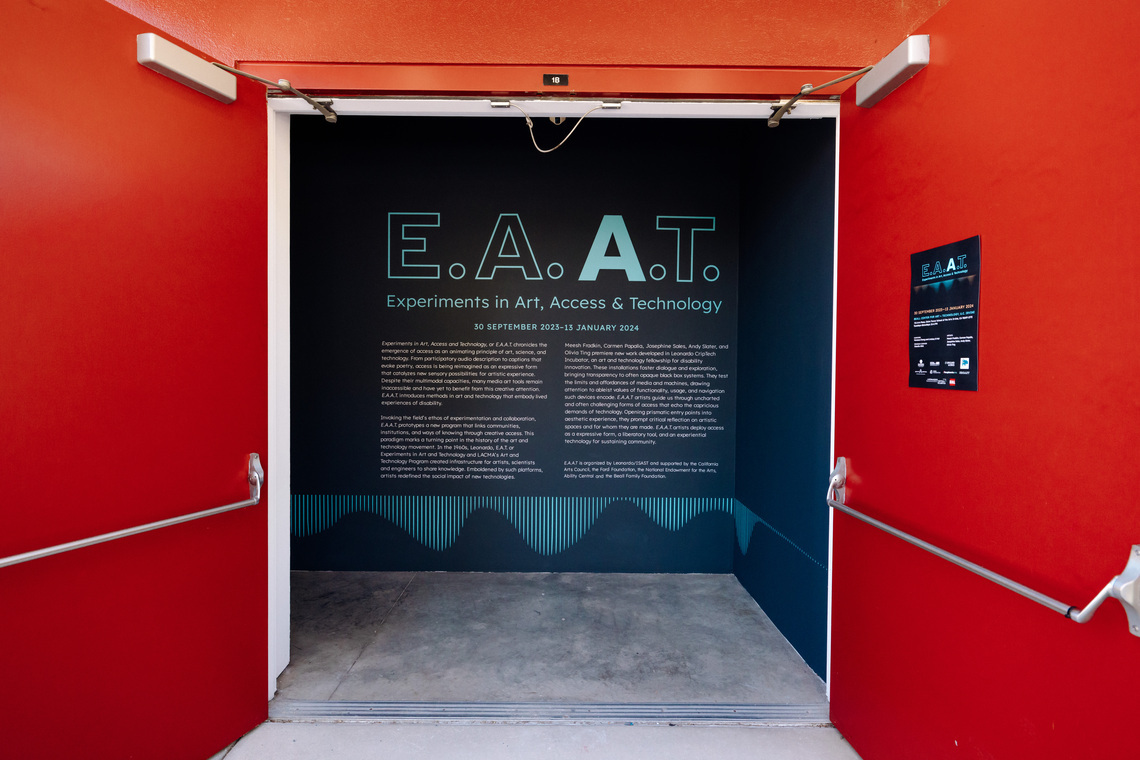
The materials gathered in this archive trace not only what the CripTech artists made, but how the CripTech Incubator helped support them through cripping art-and-technology practice itself. Since the original cohort that this archive documents, the Leonardo/ISAST CripTech Incubator has expanded to include a series of labs as “collaborative environments where disabled artists and technologists transform emergent technologies through the lens of disability innovation”.
Attribution and sources
- Portions of this introduction are adapted from, and block quotations reproduced from, Lindsey D. Felt and Vanessa Chang, “Cripping Media Art Ecologies,” Ground Works (August 4, 2022), https://doi.org/10.48807/2022.1.0011, licensed under CC BY-NC-SA 4.0.
- Details of the application and residency structure draw on “CripTech Incubator FAQ,” Leonardo/ISAST (April 23, 2021), https://leonardo.info/blog/2021/04/23/criptech-incubator-faq.
- Video excerpts are drawn from “Meet the Artists: Works-in-Progress Presentations,” a virtual event held 16 March 2022, recording published by Leonardo/ISAST, https://leonardo.info/blog/2022/06/17/meet-the-artists-works-in-progress-presentations.
- Works cited within adapted material:
- Rice, C., et al. (2018), “Cripping the Ethics of Disability Arts Research,” in The Palgrave Handbook of Ethics in Critical Research;
- Sheppard, A., and Harwell, L. (2021), op-ed in Artnet News; Hamraie, A., and Fritsch, K. (2019), “Crip Technoscience Manifesto,” Catalyst: Feminism, Theory, Technoscience 5(1).